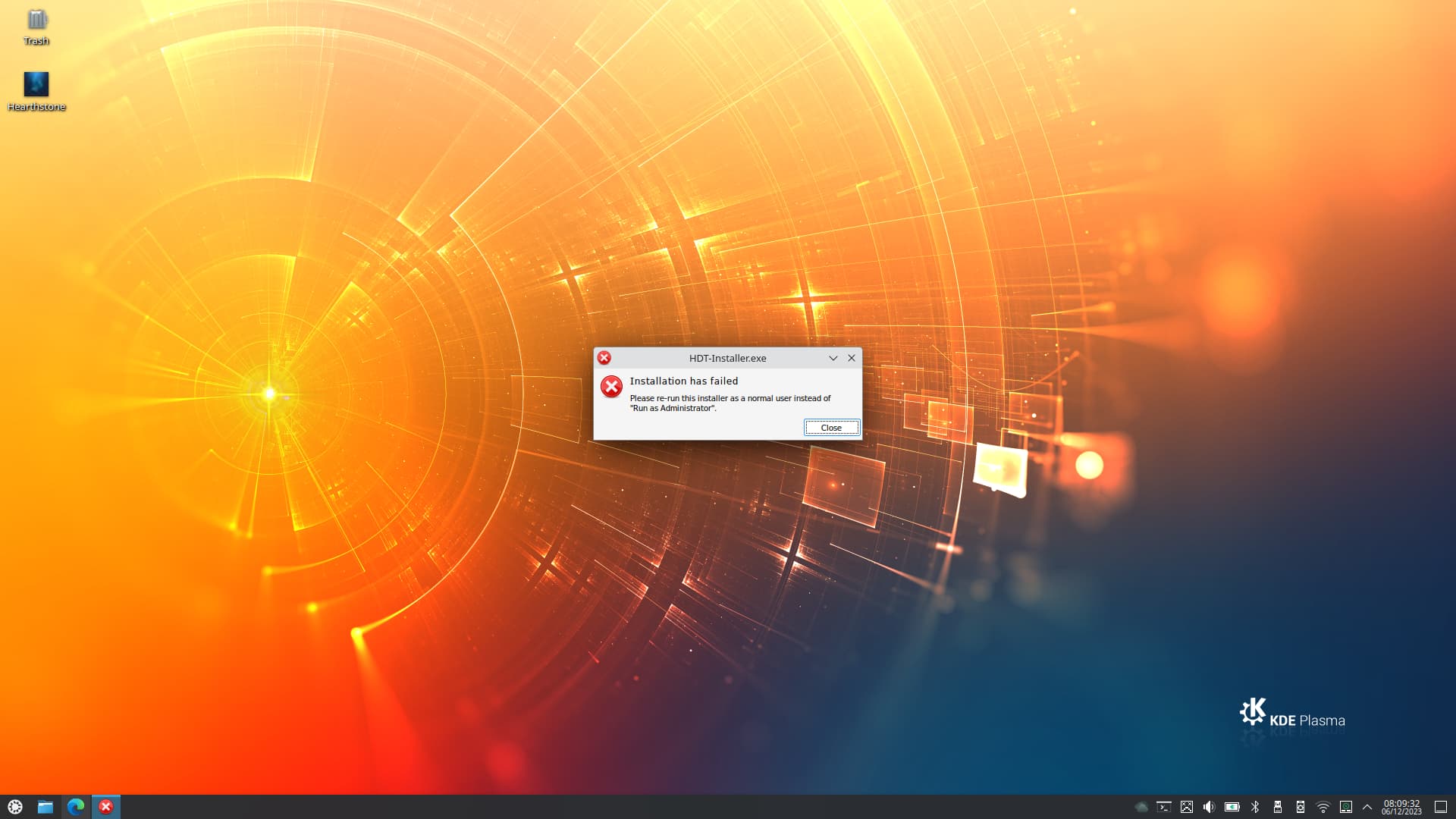
I successfully installed Hearthstone using Lutris without any issues. However, Hearthstone Deck Tracker is really a necessity. I installed Hearthstone via (+ / Install a Windows game from an executable) method in Lutris. Similarly, when I try to install HDT, I encounter the error in the screenshot. I also get the same error when I attempt to install HDT independently from Lutris using wine (after installing .NET framework with winetricks).
EDIT: This was my way to go, as of now i can’t get it to work any more on my steamdeck.
I can get it to work with mentioned “Hearthstone Deck Tracker” - . Here is how , though i used steam, not lutris. (maybe works the same with lutris if you prefer. Can’t confirm.)
1.in Steam/Lutris ; install hearthstone at least once and set it to windowed mode.
2. Grab the latest ZIP from here Releases · HearthSim/Hearthstone-Deck-Tracker · GitHub (not the exe)
3. Extract the contents of the folder into your battle net programm folder (it’s a mess, but it works so that both exes are in the same folder "battle net launcher.exe & hearthstone deck tracker .exe)
4. Select the Arena Tracker exe as the main executable, replacing battle net launcher in Steam
5. After you launch Arena Tracker select “Run Hearthstone” from within Arena Tracker
6. enjoy
Sometimes Tracker Crashes when starting up Hearthstone through arena tracker. let is sit for a minute before launching seems to work.
Tested with Steam / Proton Experimental & Arena Tracker [v1.45.05]
I find it a bit more laggy in showing the cards than using native linux programm from supertriodo but laggy tracker is better than no tracker.
Reviving this because it’s the page search engines send people to, and there’s a native option now that didn’t exist when the thread started.
First, something that applies to every tracker in this thread, including the Arena Tracker setup above — it explains the “it worked for a while then stopped” behaviour:
Hearthstone caps each log file at 10 MB per session. When it hits the cap it writes Truncating log… and then closes the file descriptor. On Windows the truncation succeeds and logging resumes; under Wine it fails, the descriptor stays closed, and any tracker reading those logs goes blind until you restart the game. It usually happens around your third match, which is why it looks random. The fix is one line in client.config, in the game’s install folder (not the prefix user folder):
FileSizeLimit.Int=-1
HDT writes this key itself when it runs, which is why it doesn’t hit the problem — but if you’re running anything else, or running HDT portable, set it by hand.
Also worth knowing: emptying the log from outside doesn’t help. The game keeps its write offset and resumes at the same position, producing a sparse file of the same apparent size (I measured 6.7 MB reported for 20 KB actually allocated).
As for the original question — I got tired of the situation and wrote a tracker that runs natively on Linux, so there’s no exe to juggle and nothing to install into the prefix at all: Cairn.
It reads the game’s log files from outside Wine rather than running inside it. ~170 MB of memory instead of the 1.5–4 GB an Electron tracker costs on top of the game, no injection, no process memory reading, no account, no telemetry. It detects Lutris prefixes automatically and can launch the game through your existing Lutris entry, and it writes the FileSizeLimit key above for you.
Since the original post is on KDE Plasma: it also ships the KWin rules, including layer=overlay, which is the only layer that will draw above the game in exclusive fullscreen on Wayland. That one took me a while to find.
Install is ./install.sh, no sudo, everything under ~/.local. MIT.
It’s v1.0.0 and I can only test on Arch/KDE Wayland with a Lutris prefix, so if it misbehaves on Proton, Heroic or another compositor, that’s exactly the report I need.